
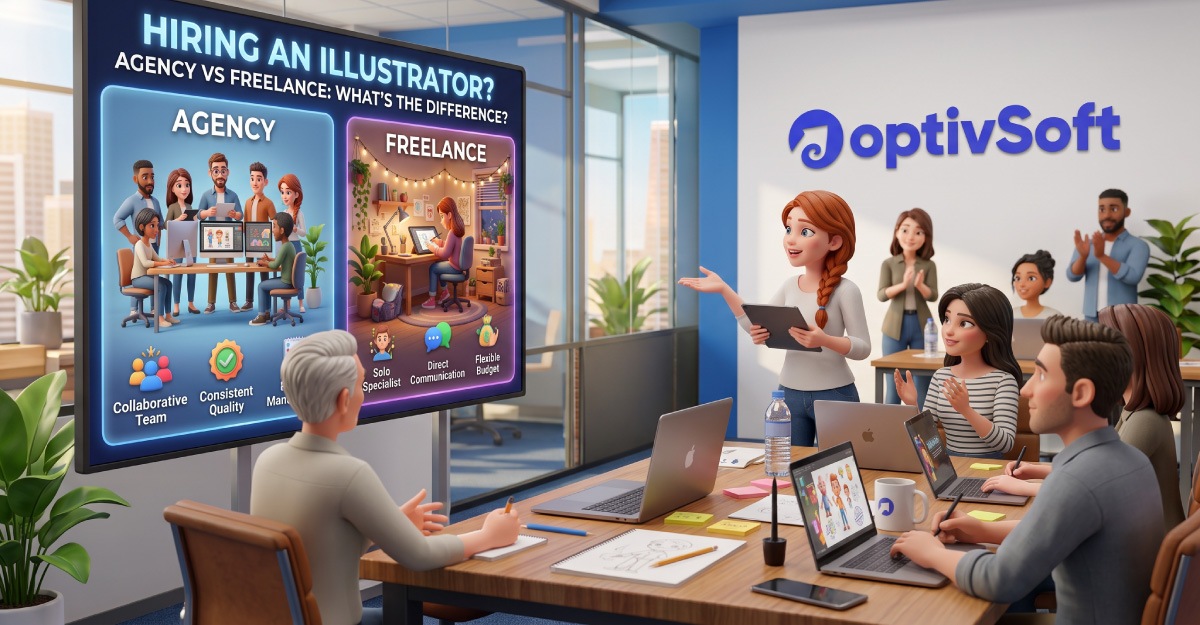
You need illustrations for a website, publication or campaign. You have found an artist whose work you like, but you are also considering an agency. Which route should you choose?
Start with the project rather than a rule about which option is better. Think about the style you need, the number of deliverables, the help you want and who will manage approvals.
This guide explains the difference and gives you a practical way to compare proposals. The examples are hypothetical situations you can adapt to your own brief.
What Is an Illustration Agency?
An illustration agency represents artists and acts as an intermediary between them and clients. Its work can include client communication, pricing, contracts and project coordination.
An agency does not necessarily mean an in-house team draws your artwork. The illustrator may be a freelance professional represented by an agent.
Ask who will create the work, who will communicate with you and which services the agency provides for your commission. Those details matter more than the word “agency” on the proposal.
What Does Hiring a Freelancer Directly Mean?
For this comparison, direct hiring means discussing and arranging the project with the illustrator rather than through a representative.
Confirm the artist’s booking process before proceeding. If their portfolio directs commercial inquiries to an agent, follow that route rather than assuming direct terms are available.
During your discussion, establish how the project will be scheduled, reviewed and delivered. You still need a clear brief and agreement when working directly with one person.
Agency vs Freelancer: A Practical Comparison
| Decision | Ask an agency | Ask a direct illustrator |
|---|---|---|
| Artist selection | Can you recommend artists for this brief? | Does your experience fit this subject? |
| Communication | Who handles creative feedback? | How should we send comments? |
| Project support | Which coordination services are included? | Which tasks will our team manage? |
| Availability | Is the selected artist available? | Does this schedule fit your workload? |
| Pricing | What does the total quote cover? | What does the total quote cover? |
| Delivery | Who checks and supplies final files? | Which final files will you supply? |
Use the answers to compare actual arrangements. Do not assume that every agency provides the same support or that every freelancer follows the same process.
When to Consider an Agency
Consider an agency if you want help finding an artist. Send a focused brief and ask why its recommendations fit your subject, audience and required formats.
You might also want coordination support for a project involving several contributors. Ask which responsibilities the agency will take and which remain with your team.
If procurement or internal approvals are complex, explain them before requesting a schedule. Check whether the agency can work within those requirements.
Evaluate the proposed support against what you need. A service is useful only if it addresses a real responsibility in your project.
When to Consider Working Directly
Consider direct hiring when you have identified a suitable artist and want to discuss a defined commission with them.
Explain the project and ask about availability, review stages and deliverables. If the artist’s process fits your team’s working habits, that gives you a basis for proceeding.
Decide who on your side will organize content, gather feedback and track approvals. A direct arrangement should still have explicit responsibilities.
For a recurring series, ask how future pieces would be booked and scoped. Do not assume an artist will remain available simply because the first project went well.
Begin with the Same Brief for Both Options
Prepare one brief before comparing providers. Include the audience, message, number of illustrations, placements and required formats.
Describe the style direction with references and explain what you like about them. Use those examples to communicate preferences rather than request copies of another artist’s work.
Also include your deadline, budget range and approval process. Identify details that must be accurate and information that is still undecided.
Comparable briefs help you understand why quotes differ. Without them, you may be comparing two different projects rather than two ways to deliver the same work.
Example: One Website Illustration
Imagine a consultancy commissioning one homepage image and two supporting crops. It has a clear message, an approved layout and one person responsible for feedback.
The team could contact a suitable artist directly or ask an agency for recommendations. It should compare the proposed concept process, availability, deliverables and total fee.
If both arrangements meet the brief, the choice may come down to which working process fits the team. There is no reason to assume the agency route requires several artists or that the direct route excludes professional project management.
Example: A Larger Campaign
Now imagine a campaign requiring a main illustration, several supporting images and adaptations for different layouts. Several departments will review the work.
Before choosing a provider, map the approvals and identify which assets depend on the main concept. Ask how that sequence will be scheduled.
If you want agency coordination, specify what it should cover. If you prefer a direct illustrator, discuss the full workload and what production assistance may be needed.
In either case, confirm capacity for the actual scope. A large roster or a strong portfolio alone does not establish availability for your deadline.
How to Compare Illustration Costs
Request quotes that identify the artwork, review stages, adaptations and final files. Ask how additional requests will be priced.
Compare the total amount and included work. Avoid treating an agency fee as a fixed surcharge or assuming direct hiring is always less expensive.
Discuss the intended uses of the artwork with each provider. Make sure the quote reflects the same placements and requirements before comparing it with another.
Keep an allowance for unresolved decisions. If you have not finalized the campaign formats, tell the provider rather than expecting every later variation to fall within the initial price.
Make Communication Responsibilities Clear
Name one contact on your side who collects feedback and communicates approvals. Ask the provider to identify its corresponding contact.
Agree on how comments should be submitted. A marked-up document or a consolidated list can give everyone a shared reference.
When giving creative feedback, identify the problem you see. “The product is difficult to recognize at this size” is more useful than “make it stronger.”
If several people disagree, resolve their priorities internally before sending conflicting instructions. The illustrator needs a decision they can act on.
Review the Artwork in Stages
Ask for the proposed review sequence before work begins. Identify when the concept, composition and final treatment will be approved.
At the concept stage, focus on meaning. Later, review details and the fit within the intended layout.
Test the artwork at its planned sizes. Check whether important features survive cropping and whether surrounding text interferes with the image.
If you change an approved direction, discuss the impact on scope and timing. Record the revised agreement before asking for further production work.
Discuss Usage and Delivery Before Commissioning
List where you plan to publish the illustration and whether you expect adaptations, animation or future reuse. Ask the provider to explain the proposed terms and record the agreed arrangement.
Confirm file formats, dimensions and whether editable files are included. Do not assume a working file is part of every commission.
Also clarify how final approval, payment and file delivery will be handled. If another supplier will prepare the artwork for print or motion, include its requirements in the discussion.
This guide is a project-planning comparison. For any agreement you do not understand, get an appropriate explanation before accepting it.
Questions to Ask Before Choosing
- Who will create the illustration?
- Why does this artist fit our brief?
- Is the proposed schedule confirmed?
- Who receives feedback and approves each stage?
- What revisions and adaptations are included?
- What happens if our requirements change?
- Which final files and usage terms are included?
- What responsibilities remain with our team?
For OptivSoft readers, keep the answers beside each proposal. A simple comparison of responsibilities often reveals more than looking at the quoted fee alone.
How to Make the Final Decision
Choose the arrangement that gives you a suitable artist, a workable schedule and a clear process within your budget.
If you need help selecting an artist, ask for that support. If you already have a preferred artist, check their commercial contact route and availability.
Resolve unclear terms before committing. Both routes should leave you knowing who creates the work, what will be delivered and how decisions will be made.
Your next step can be a short brief and a focused inquiry. That gives prospective providers enough information to discuss whether the project fits.
Frequently Asked Questions
Common Question
Answers to common questions about commissioning through an agency or directly.
Do not assume so. Agencies can represent freelance artists. Ask who will create your artwork and how the project will be managed.
Compare actual quotes for the same scope and planned usage. Neither route establishes the price by itself.
Follow the artist's stated inquiry process. If commercial requests are directed to an agent, use that contact route.
Check artist fit, availability and the proposed process. Either arrangement may meet a clearly defined small brief.
Ask for a confirmed schedule based on the selected artist and project requirements. Do not infer delivery speed from the provider's label.
Ask it to identify the deliverables, review stages, included revisions, schedule and planned usage. Clarify extra-work charges.
Compare responsibilities, communication, artist fit and total cost. Choose the arrangement that best matches how your team can manage the project.
